If you have been around the PLM industry for as long as I have, you probably remember installing Agile on your server using a series of floppy disks and knowing you were on the verge of taking control of your product data. Under Oracle’s ownership, Agile became wildly popular, particularly in the Med Device and High-Tech industries, but software has evolved and it is time for the sun to go down on the beloved product.
For many companies in the highly regulated Medical Device industry Agile PLM has become gospel. Customer retention has been so robust that companies continue to rely on it despite the longstanding announcement of end of life at the end of the year. Almost every PLM company on the market has seen the Agile base as a target for migration, and yet there is still a lot of Agile code still in use “in the wild.” Clearly it is doing what it needs to do for the companies who are using it, but the dawning of AI is making customers wake up to the idea of breaking their product data out of the engineering silo.
The final end of life for Agile comes at the perfect time for Oracle. Oracle Fusion PLM Cloud has been rolling out features identical to the functionality Agile users love, and more importantly, users are now recognizing that AI strategy will clearly be an accelerant in PLM differentiation. Oracle AI Agent Studio is going to bringing artillery to the fight that is far beyond some of the basic chat bots other companies are talking about. The PLM roadmap session was standing room only, which is impressive for an 8AM technical breakout in Las Vegas.
Enterprise AI platform
Unlike many PLM companies, Oracle AI agents can be created, managed, organized, and controlled inside of a framework developed to manage people and data with humans in the loop. (HCM) Managing product data inside of an ERP environment means no integrations, and no loss of fidelity between organizations. AI is built in, not bolted on, and humans are poised to define and control the next generation workforce that can handle an agentic army work side by side with humans.
Customer Success
Of course the final proof that Fusion applications are ready to complete the transition is in looking at customers who have moved. At AI World we heard from several, and I was able to follow up those conversations with partners who supported them
Eric Arden with NetApp discussed their recent migration from PLM & ERP to ERP with integrated PLM including comprehensive management of ideation and the digital supply chain. The benefits of native master data management have been talked about for many years, and this next generation of ERP/ PLM solutions are bound to get a boost from users looking to have a cohesive digital thread.
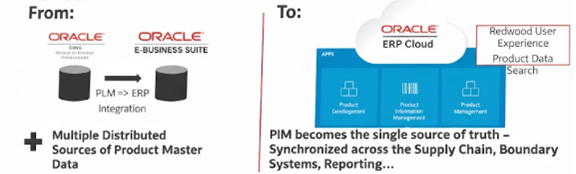
Rich O’Brien from Zoll defibrillators presented on their similar roadmap to a go live, and in their case PLM was launched prior to Cloud ERP. My takeaway from this new deployment was the importance of working with an implementation partner. In this case Zoll presented alongside Apps Associates. In the vein of pointing users to Oracle PLM resources I have to mention the CAD data integration I saw through GoSaaS as an option for PDM vaulting.
A Challenge to Oracle
As much as I love the idea of embedding PLM into a company’s digital backbone and supply chain, I seriously want to see application native 3D visualization along with 3D PMI. That would be the icing on the cake for finally seeing ERP based PLM that people will want to use across the enterprise.
Leave a Reply